


Missouri's Hub & Spoke Model Explained
Learn about Missouri's unique Hub and Spoke Model below.
Missouri’s Rural Health Transformation Program: ToRCH Care
Missouri’s Rural Health Transformation Program, known as ToRCH Care (Transformation of Rural Community Health), is the state’s strategy for implementing RHTP across Missouri.
ToRCH Care is a state-led initiative managed by the MO HealthNet Division within the Missouri Department of Social Services (DSS) through the Rural Health Transformation Office. The program is designed to strengthen rural healthcare infrastructure, support local partnerships, and create a more coordinated approach to serving rural communities.
Missouri DSS announced that the Centers for Medicare & Medicaid Services (CMS) has approved $216,276,817.66 in Year 1 (through September 30, 2027) funding for the state’s Rural Health Transformation Program (RHTP)
Missouri’s strategy focuses on five key areas:
-
Access to Care - Expanding access to essential services, including primary care, behavioral health, and maternity care.
-
Sustainable Operations - Supporting rural healthcare organizations as they collaborate, share resources, and strengthen long-term stability.
-
Workforce Development - Supporting efforts to recruit, train, and retain healthcare professionals needed in rural communities.
-
Preventive and Value-Based Care - Encouraging approaches that emphasize prevention, early intervention, and improving health outcomes.
-
Technology and Innovation - Supporting the use of digital health tools, telehealth, and other technologies that improve connections between patients and providers.
Missouri’s Hub and Spoke Model
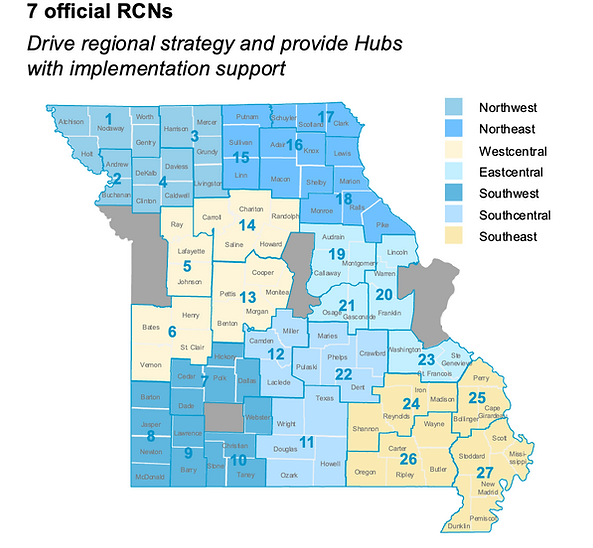
To implement ToRCH Care statewide, Missouri is establishing a Hub and Spoke model, a framework that organizes rural healthcare partnerships and creates a structure for coordination at the local and regional levels.
The model is built around two connected components: Regional Coordination Networks (RCNs) and Community Hubs.

Community Hubs: Local Coordination
Rural Health Hubs serve as the community-level foundation of Missouri’s model.
Each Hub brings together healthcare and community partners across approximately three to five counties to create a coordinated network of organizations working within a shared geographic area, intended to reflect the unique needs and existing partnerships of the communities it serves.

Hub partners may include:
-
Rural hospitals and clinics
-
Rural Health Clinics (RHCs)
-
Pharmacies
-
Emergency Medical Services (EMS)
-
Behavioral health providers
-
Community-based organizations
-
Other local partners
Within each Hub, participating organizations will collaborate to:
-
Identify local priorities and community needs
-
Improve connections between services
-
Strengthen referral pathways
-
Coordinate resources across organizations
-
Develop solutions based on local conditions
Each Rural Health Hub will have a designated Hub Anchor organization that supports coordination among participating partners.
Hub Anchors will help organize Hub operations by:
-
Supporting Hub governance and Leadership Board activities
-
Coordinating communication between partners
-
Hosting Hub staff and supporting implementation
-
Helping maintain effective coordination processes
Regional Coordination Networks (RCNs)
Regional Coordination Networks (RCNs) provide support across multiple Hubs by helping connect local efforts and strengthening regional coordination.
RCNs support the broader structure by:
-
Connecting Hubs across regions
-
Supporting implementation efforts
-
Facilitating information sharing
-
Helping align local activities with statewide goals
Together, Hubs and RCNs create a connected framework that allows local organizations to lead community-based efforts while benefiting from regional coordination and support.
Missouri Association of Rural Health Clinics
PO Box 296, Jefferson City, MO 65102
The Missouri Association of Rural Health Clinics is managed in partnership with the Missouri Rural Health Association.